
Yes, You Can Take Notes Into an Interview. Just Do Not Bring a Script.
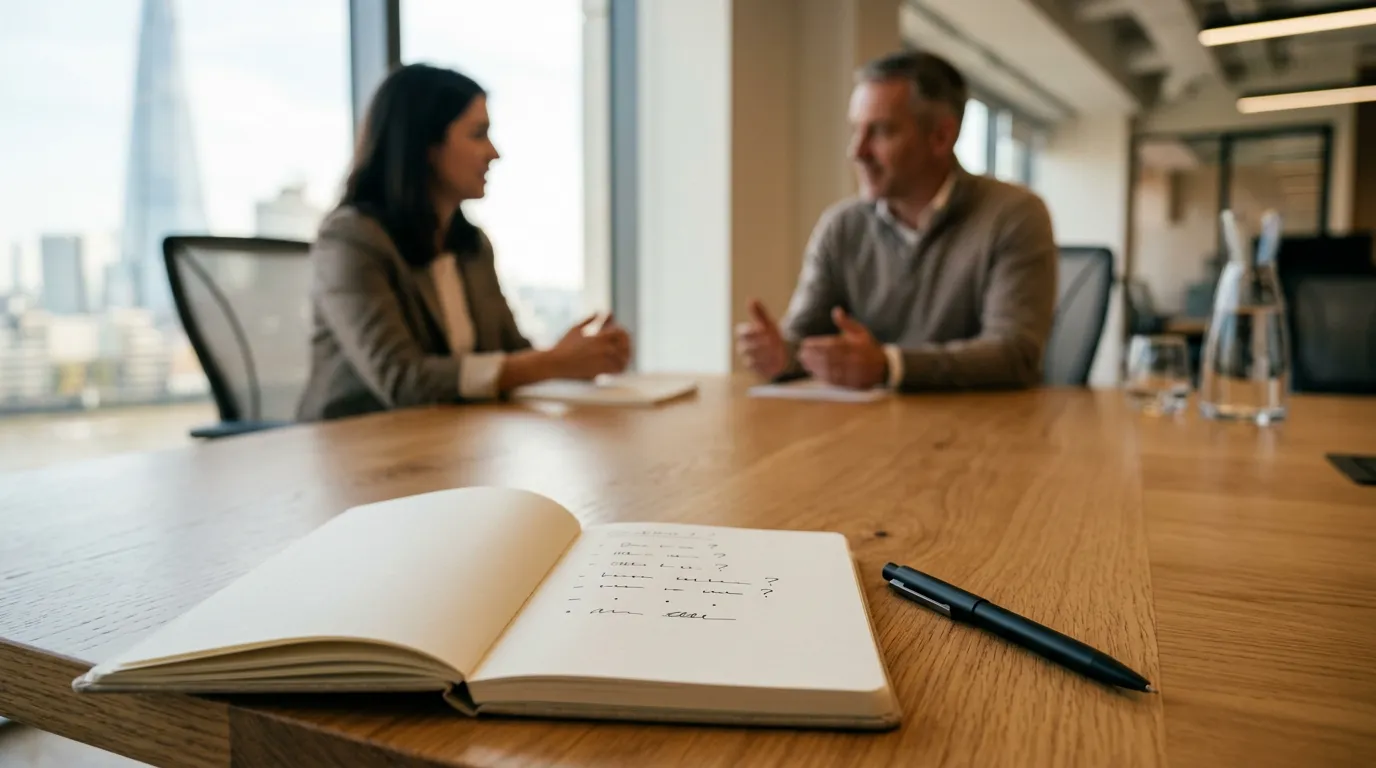
The short answer is yes. You can take notes into an interview.
The better answer is this: bring notes that help you listen, remember, and give sharper evidence. Do not bring notes that turn the interview into a reading exercise.
That distinction matters more in 2026 than it did a few years ago. Hiring is more competitive, recruiters are using more AI, and employers are putting more weight on evidence of skills. A good note sheet can help you stay specific. A bad one can make you look like you have memorised someone else's answer.
The National Careers Service explicitly says you can write down the question or refer to your notes if you need to. Indeed's interview guidance says notes are appropriate when they contain questions for the interviewer or short highlights about your skills and experience, but warns against relying on notes to answer every question.
That is the line. Notes are fine. Dependency is not.
The goal is not to smuggle a tiny essay into the room. It is to stop your best example disappearing the moment someone says, "Tell me about a time when..."
Why This Question Is Trending Now
People are asking about interview notes because interviews feel less predictable.
LinkedIn's 2026 talent research found that US applicants per open role have doubled since spring 2022. It also found that 65% of people say finding a job has become more challenging, while 66% of recruiters say it has become harder to find qualified talent. That is an odd market: candidates feel crowded out, and recruiters still feel short of signal.
Then add AI. LinkedIn reports that 93% of recruiters plan to increase their use of AI in 2026, and 66% plan to increase AI use for pre-screening interviews. If you are a candidate, that changes the emotional temperature of the process. You are not only preparing for a person. You are preparing for a process that may include screening tools, structured scoring, and faster filtering.
The labour market is not helping nerves either. The US Bureau of Labor Statistics reported 7.6 million job openings in April 2026, with quits little changed at 3.0 million and a 1.9% quits rate. In the UK, ONS vacancy data shows vacancies fell to 705,000 in February to April 2026, down 7.1% year on year and 10.6% below the pre-pandemic January to March 2020 level.
So yes, candidates are bringing notes. Not because they are lazy. Because the room feels higher-stakes, and the margin for vague answers is smaller.
There is also a very normal human reason: silent preparation lies to you. You read your notes, everything sounds tidy, and then the first spoken version arrives in the interview with three extra detours and a surprise ending. Your brain had excellent PR. Your mouth had not been briefed.
What Interviewers Actually Notice
Interviewers do not usually care that you have notes. They care how you use them.
A quick glance at a bullet point before answering a question is normal. Writing down a salary detail, a team structure, or a next step is sensible. Looking down for 40 seconds while you read a pre-written answer is a problem.
The signal you want to send is: "I prepared carefully and I am listening."
The signal you do not want to send is: "I cannot talk about my own experience without a script."
That is why one page is plenty. If you need six pages, you do not have interview notes. You have a dependency.
Six pages also creates its own tiny admin problem. By the time you find the right bullet, the interviewer has aged slightly.
The 1-Page Interview Notes Format
Use one sheet. Keep it scannable. You should be able to find any line in under two seconds.
Think of the sheet as a map, not a teleprompter.
1. The role in 5 words
At the top, write a blunt summary of what they are really hiring for.
Examples:
- "Customer support, angry users, retention"
- "Junior analyst, Excel, stakeholder updates"
- "Team lead, delivery, coaching, change"
- "Product manager, discovery, prioritisation, metrics"
This keeps you anchored. If an answer does not connect to the real job, it is probably too generic.
2. The top 4 requirements
Pull these straight from the job description.
Do not copy the whole advert. Reduce it to the four things they are most likely to score.
For example:
| Requirement | Evidence prompt | |---|---| | Stakeholder communication | Finance dashboard rollout | | Prioritisation | Backlog reset after missed sprint | | Customer handling | Refund escalation project | | Data confidence | Weekly churn report |
This matters because employers are becoming more skills-led. Indeed Hiring Lab analysed millions of US job postings from Q4 2025 and found business operations skills in more than 70% of postings. Customer service and administrative skills alone appeared in 37.1% and 35.8% of postings. Those are not abstract traits. They are things you need to prove with examples.
3. Four STAR story prompts
Use the STAR method to choose the stories, then do not write the whole answer. Write the trigger.
Bad notes:
"In my previous role I demonstrated leadership when our project was delayed because I took ownership and communicated with stakeholders..."
Good notes:
- "Delayed payroll rollout - owned comms - 4-day recovery"
- "Difficult customer refund - policy exception - retained account"
- "Junior colleague underperforming - weekly coaching - passed probation"
- "Reporting error - caught before board pack - new checklist"
The good version keeps your brain pointed at the right story without forcing you to read.
That is the whole trick. Memorise the order of ideas, not the wording.
4. Three company facts
Write down three facts that prove you have done real research.
Use facts you can naturally connect to the role:
- A recent product, funding, policy, campaign, or hiring push
- A challenge in their market
- A value or operating principle that actually appears in their work
Do not write a flattery paragraph. Interviewers hear enough of those.
5. Three questions for them
This is the safest and most useful part of interview notes.
Good questions:
- "What would success look like in the first 90 days?"
- "Which skill gap would make someone struggle in this role?"
- "How does the team currently measure quality?"
These questions do two jobs. They give you better information, and they show the interviewer that you are thinking about fit, not just trying to pass.
"No, I think you've covered everything" feels polite, but it gives away the last useful minute of the interview. Two prepared questions usually beat a graceful shrug.
For examples worth putting on that sheet, see our guide to questions to ask at the end of an interview.
6. Blank space for live notes
Leave room to write:
- Names
- Team structure
- Salary or benefits details
- Working pattern
- Next steps
- Follow-up points
This is especially useful when you have several rounds. The detail from round one often becomes useful in round two.
What Not to Bring
Some notes create risk.
Do not bring full scripted answers
Scripted answers sound worse than candidates think. They flatten your voice, slow down the conversation, and make follow-up questions harder because you were never really speaking naturally.
If you need a script to remember the story, you have not practised the story enough.
Memorised scripts are brittle. The interviewer only has to ask the question slightly differently and the beautiful answer can come out polished, confident, and not quite relevant.
Do not bring AI-written answers
AI can help you organise your thinking. It cannot own your experience.
If you paste a job description into a tool and print the answers it gives you, the language will probably sound polished and empty. Worse, it may make claims you cannot defend under follow-up.
Use AI for prompts if you want. Rewrite everything into your own words before the interview.
Do not bring private information
Do not bring confidential client names, unreleased numbers, internal strategy, or anything from a current employer that you would not be allowed to share.
You can still be specific without being careless:
- "A regulated financial services client"
- "A seven-person operations team"
- "A high-volume support queue"
- "A reporting process used by senior leadership"
Specific does not have to mean exposed.
Do not use your phone as the note sheet
A phone is a weak interview prop. It looks like distraction even when it is innocent.
It also gives your thumb something to do, which is rarely a gift in an interview.
Use paper, a notebook, or a clean document on the same screen for a video interview. If you use a laptop in person, ask first.
What to Say When You Use Notes
You do not need a big explanation.
Use one of these:
- "I have brought a few notes so I do not miss the examples most relevant to the role."
- "Is it okay if I make a couple of notes as we go?"
- "I wrote down a few questions for you. I may refer to them at the end."
- "Let me check the exact figure, because I do not want to guess."
That last one is underrated. Accuracy is better than bluffing.
How to Use Notes in a Video Interview
Video interviews make note-taking easier and easier to get wrong.
Keep your notes near the camera. If they are on a second monitor, your eyes will keep sliding sideways. The interviewer may not know what you are looking at, but they will feel the loss of eye contact.
Use a sticky note or half-page prompt sheet with:
- 4 story prompts
- 3 company facts
- 3 questions
- 1 reminder: "Answer the question first"
That final reminder is there because nervous candidates often start with background. Start with the answer, then add context.
If your STAR answer spends twelve minutes in Situation, it is no longer STAR. It is a documentary.
A Before and After Example
Here is what notes look like when they are doing too much.
Too much:
"When asked about conflict, say that I believe communication is very important. Mention that I always try to listen to different perspectives and resolve issues collaboratively. Talk about the warehouse scheduling issue and say I created alignment."
That is not a prompt. That is a script made of vague phrases.
Better:
"Conflict - warehouse rota - 3 supervisors - changed handover - absenteeism down"
Now you can speak like a person:
"A good example was a rota dispute between three warehouse supervisors. The issue was not really the rota, it was that shift handovers were inconsistent, so each supervisor thought the others were leaving extra work. I pulled the last four weeks of missed handover notes, set up a 20-minute reset, and agreed a shared checklist. Within a month, missed handovers dropped and the rota stopped becoming a weekly argument."
That answer feels prepared, but not memorised.
Notice the difference. The note is rough. The answer is specific. That is what you want.
Why Notes Can Help in Skills-Led Interviews
The direction of hiring is clear. Employers are looking less at credentials and more at proof.
LinkedIn's 2026 Skills on the Rise report says employers are increasingly prioritising skills over degrees, job titles, or linear career paths. The World Economic Forum forecasts that structural labour-market transformation will affect 22% of jobs by 2030. Microsoft also reports that AI users increasingly see human judgement as central, with 50% naming quality control of AI output and 46% naming critical thinking as more important as AI takes on more work.
That is the useful way to think about notes. They are not there to help you survive basic questions. They are there to help you bring better evidence to a process that is asking for more evidence.
If your notes help you say "I reduced backlog by 18%" instead of "I improved the process", bring them.
If your notes help you ask a sharper question about the role, bring them.
If your notes stop you listening, leave them at home.
The Bottom Line
Can you take notes into an interview? Yes.
Bring one page. Use bullets. Ask before taking live notes. Refer to your prompts briefly, then look back up and answer in your own words.
The aim is not to look perfectly polished. It is to be clear, specific, and present.
Good notes do not make you look unprepared. They make your preparation visible.