
Start with the employer, not yourself
"Why should we hire you?" sounds like an invitation to sell yourself.
That is where many answers go wrong.
Candidates start listing adjectives: hardworking, passionate, organised, a team player. The answer gets longer, but the evidence never arrives. By the end, the interviewer has heard six positive words and learned almost nothing.
A better answer starts with the job.
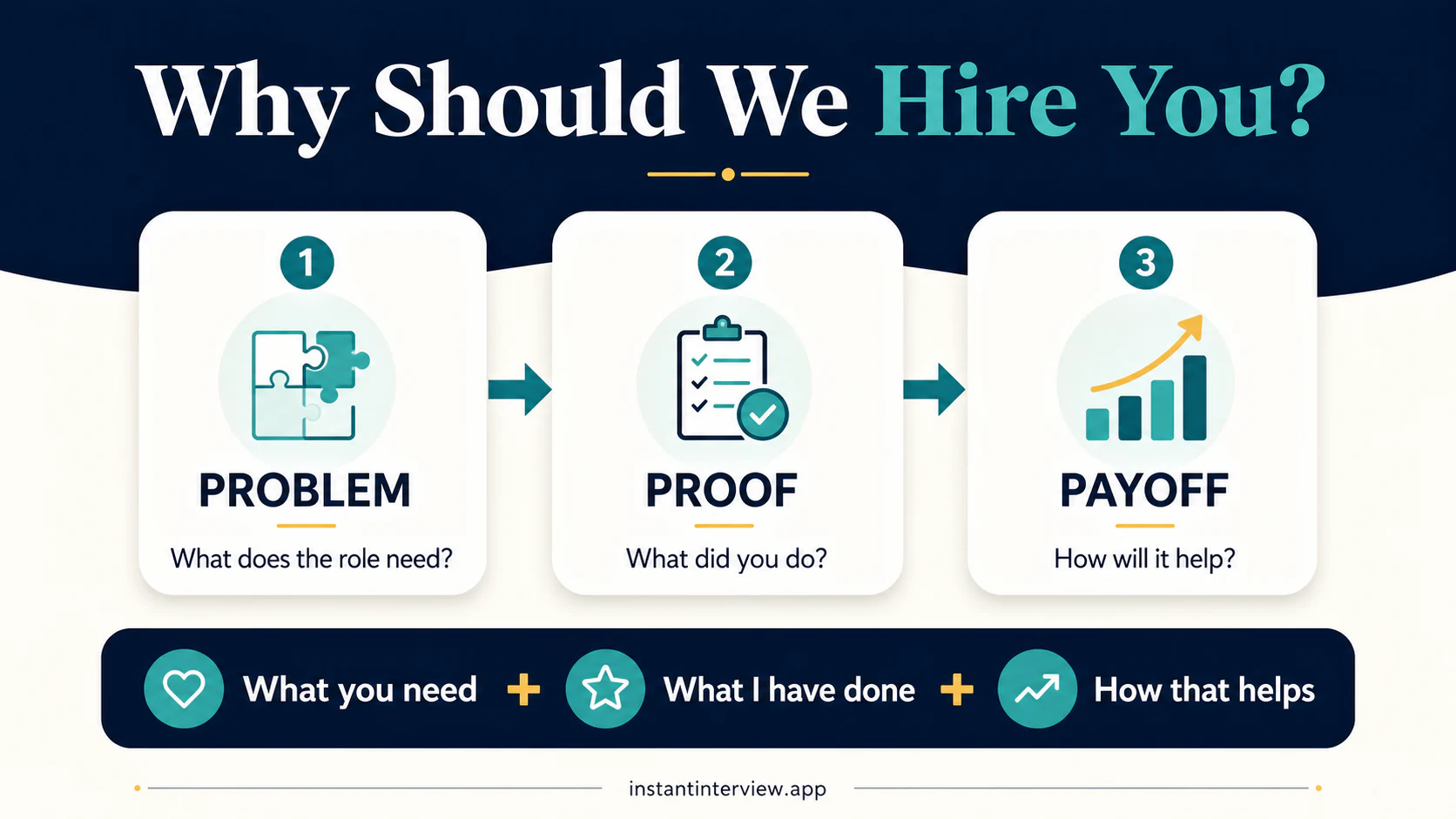
What problem does this employer need the new hire to solve? What evidence shows you can help? What useful result could follow?
That is the whole structure:
Problem. Proof. Payoff.
It works because the hiring market has a strange problem in 2026. Employers have more applicants, yet many still struggle to identify people who can do the work.
LinkedIn's 2026 talent research found that US applicants per open role have doubled since spring 2022. At the same time, 66% of recruiters said finding qualified talent had become harder over the previous year. More applications have not made the decision easier.
The interview is where you turn claims into evidence.
Why this question matters more in 2026
Recruiters are using more automation before candidates reach a human conversation. LinkedIn reports that 93% of recruiters plan to increase their use of AI in 2026, while 66% plan to increase AI use for pre-screening interviews.
That makes a clear spoken answer more valuable, not less.
An application can say you have stakeholder management, analytical thinking, or customer service skills. In the interview, you have to show what those words mean when something went wrong, a deadline moved, or a customer needed an answer.
The UK market is also giving employers more choice. Office for National Statistics data published on 19 May 2026 put UK vacancies at 705,000 for February to April 2026, down 7.1% from a year earlier. There were 2.5 unemployed people per vacancy, up from 2.1 a year before.
That does not mean you need to perform a dramatic sales pitch. It means vague answers are easier to reject.
The 3-part answer
1. Problem: show that you understand the role
Open with the two or three things the employer appears to need most.
You can usually find them by reading the job description and looking for repetition. If "prioritise competing deadlines" appears in the summary, responsibilities, and person specification, it is not decorative. It is probably part of the reason the vacancy exists.
Your first sentence might sound like this:
"You need someone who can manage a busy client workload, keep projects moving, and communicate clearly when priorities change."
That is stronger than:
"You should hire me because I am hardworking and a great communicator."
The first version is about their problem. The second asks them to accept your self-review.
2. Proof: give one example they can test
Now add a short piece of evidence.
NACE's Job Outlook 2026 Spring Update found that employers want candidates to do more than list skills. They want examples. NACE also reported that communication, teamwork, professionalism, and critical thinking were among the most important skills for new graduates.
So do not say, "I have strong critical-thinking skills." Use the STAR method to turn the strength into a concrete example instead.
Say:
"In my current role, I reorganised our weekly client review around risk and deadline rather than account size. Over three months, late handoffs fell from nine to two."
The number helps, but the real strength is the chain of thought. You noticed a problem, changed the process, and can describe the result.
If you do not have a neat metric, use a concrete outcome:
- A deadline was met.
- An error was caught.
- A complaint was resolved.
- A process became easier to follow.
- A manager adopted your recommendation.
- A team stopped repeating the same mistake.
"It went well" is not a result. It is what people say when the result has left the building.
3. Payoff: connect your evidence to their next step
Finish by stating how that experience could help in this role.
"That experience would help me get on top of the workload quickly and give clients clear updates before small issues become missed deadlines."
Notice the wording. It does not promise that you will transform the company by Tuesday. It makes a reasonable connection between past evidence and future value.
Put together, the answer becomes:
"You need someone who can manage a busy client workload, keep projects moving, and communicate clearly when priorities change. In my current role, I reorganised our weekly client review around risk and deadline rather than account size, and late handoffs fell from nine to two over three months. That experience would help me get on top of the workload quickly and give clients clear updates before small issues become missed deadlines."
That takes about 45 seconds to say at a calm pace.
What employers are really asking
The question is not asking you to prove that you are a remarkable person in every category.
It is asking whether your skills match the work that matters now.
Indeed Hiring Lab analysed millions of US job postings from the final quarter of 2025. Business operations skills appeared in more than 70% of postings, far ahead of any other broad skill category. Indeed's analysis included project management, administration, HR, and business analysis.
That finding is useful even if you work in a technical or specialist role. Employers want to know that you can do your craft inside a functioning organisation. Can you prioritise? Can you explain a decision? Can you connect your work to a customer, deadline, cost, risk, or team outcome?
The World Economic Forum's Future of Jobs Report 2025 adds another reason to stay specific. Its survey of more than 1,000 global employers found that 39% of workers' existing skill sets are expected to change or become outdated by 2030. It also found that 70% of employers expect to hire people with new skills.
A good answer should therefore show two things:
- You can solve a current problem.
- You can learn when the problem changes.
Examples for different situations
Graduate or first-job answer
"You need someone who can learn the process quickly, stay accurate, and communicate well with customers. In my part-time retail job, I was asked to train four new starters during our busiest month, so I turned the common till and returns errors into a one-page checklist. It gave them something practical to use during shifts and reduced the number of times a supervisor had to step in. I would bring that same habit of learning quickly and making the work clearer for other people."
This works because it does not apologise for limited experience. It uses the experience available and connects it to the role.
Career-change answer
"The role needs someone who can understand complex information, work with different stakeholders, and turn it into a clear plan. In healthcare administration, I regularly coordinated between clinicians, patients, and finance teams when information was incomplete or urgent. That has taught me how to ask the right questions and keep people aligned, which is directly relevant to the project coordination work in this role."
The bridge is clear. The candidate is not pretending the two jobs are identical. They are identifying a useful pattern that transfers.
Experienced-candidate answer
"You need someone who can improve delivery without losing the trust of the team. In my last role, I inherited a reporting process that took two days every month and produced inconsistent figures. I worked with finance and operations to agree one definition set, then automated the repeatable checks. The process now takes three hours, and managers use the same numbers in their reviews. I could bring that mix of process improvement and stakeholder alignment to this team."
The answer gives technical proof and human proof. Both matter.
Common mistakes
Claiming you are the best candidate
You have not met the other candidates. The interviewer has. Do not build your answer around a comparison you cannot support.
Say why you are a strong fit. Let the panel decide the ranking.
Repeating your CV
The interviewer can already see your job titles and qualifications. Use the answer to interpret them.
Choose the evidence that best matches this role, even if it is not the most impressive line on your CV.
Giving five reasons
One sharp example beats five unsupported strengths.
When candidates try to cover everything, the result often sounds like a supermarket sweep through the person specification. Pick the employer's main need and build a case around it.
Making it entirely about enthusiasm
Enthusiasm helps, but it is not proof.
"I really want the opportunity" explains your interest. It does not explain why hiring you is a sensible decision.
A 10-minute preparation method
You do not need to write a speech. Prepare the order of ideas.
- Circle the three most repeated requirements in the job description.
- Choose the one requirement that seems closest to the employer's immediate problem.
- Find one example that proves you have handled something similar.
- Write down the action you took and the result.
- Add one sentence connecting that result to the new role.
- Say the answer out loud twice and keep it under 60 seconds.
Do not memorise every word. Memorise the route:
What you need. What I have done. How that helps.
If the interviewer interrupts or asks a follow-up, you will still know where you are.
A final answer template
Use this as a starting point:
"From the job description, it looks like you need someone who can [priority one] and [priority two]. In my [job, course, project, or voluntary work], I [specific action], which led to [specific result]. That experience would help me [useful contribution in the new role], and I am ready to keep developing in [important changing skill]."
Then remove any words you would never say in real life.
The goal is not to sound polished enough to be laminated. The goal is to make the hiring decision easier.
Problem. Proof. Payoff.
That is a much stronger reason to hire you than "I am passionate and hardworking." For the paired motivation question, use the "why do you want to work for us?" framework to connect the employer's work to your contribution.
Jacob