
The answer interviewers are actually listening for
"Why do you want to work for us?" looks like a motivation question. In 2026, it is also a filtering question.
Hiring teams are dealing with more applications, more AI-written CVs, and less patience for vague answers. LinkedIn's 2026 talent research says US applicants per open role have doubled since spring 2022, while 66% of recruiters plan to increase AI use for pre-screening interviews this year. In the UK, ONS vacancies fell to 705,000 in February to April 2026, down 7.1% year on year and the lowest level since February to April 2021.
That is why a soft answer like "I love the company culture" is not enough. Interviewers are listening for evidence that you understand the job, the company, and the problem they are hiring you to solve.
The best answer is not flattery. It is proof of fit.
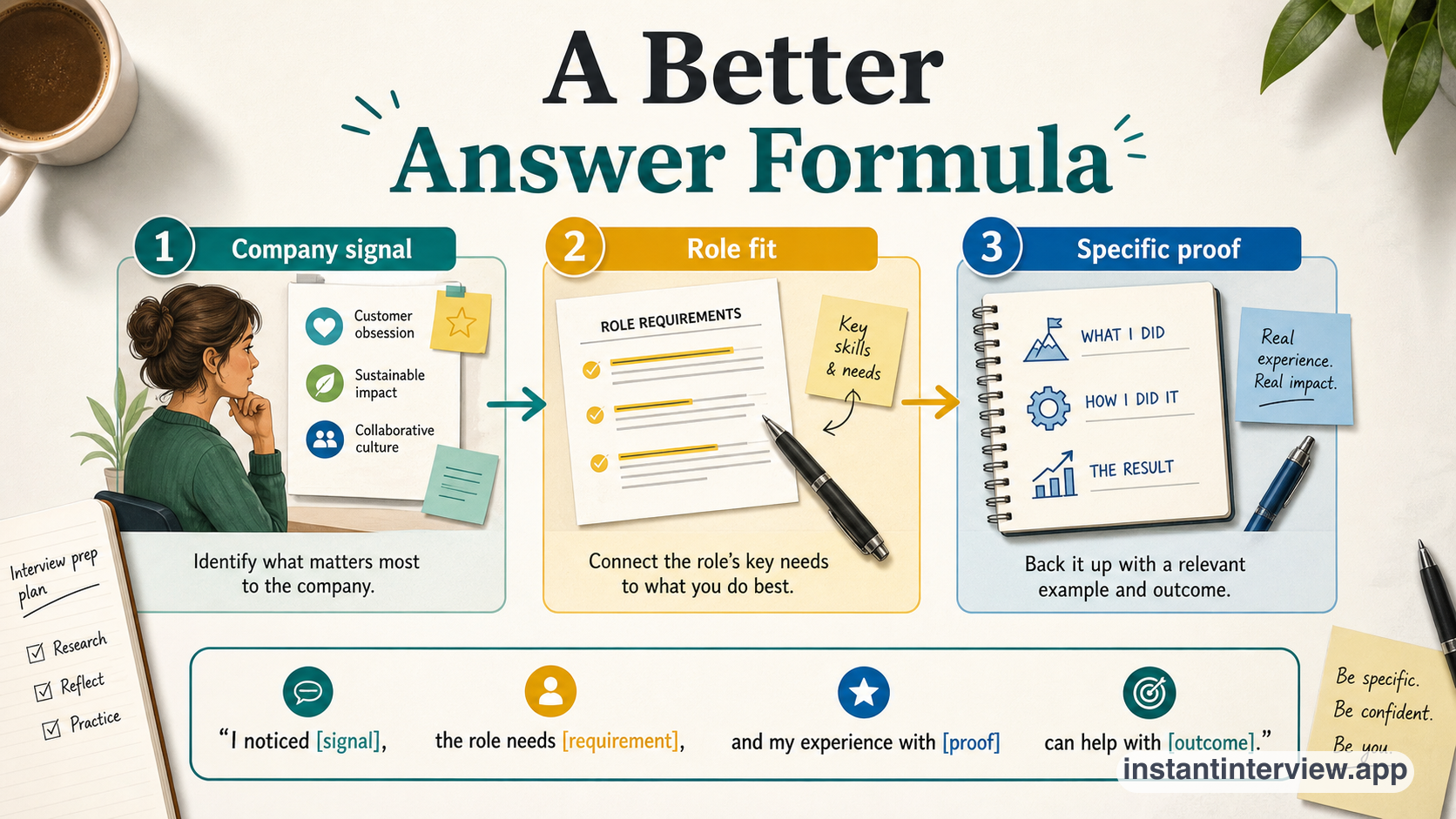
The simple formula
Use this structure:
| Part | What to say | What it proves |
|---|---|---|
| 1. Company signal | Name one specific thing you noticed about the company. | You did real research. |
| 2. Role fit | Connect that signal to one requirement in the job. | You understand the work. |
| 3. Contribution | Explain what you can bring, using a real example. | You can help, not just benefit. |
In one sentence, the shape is:
"I want to work here because [specific company signal] matches [specific role requirement], and my experience with [relevant proof] means I can contribute to [specific outcome]."
That is compact enough to remember and specific enough to sound human.
Why generic answers are getting weaker
The question has become more important because hiring teams are trying to separate serious candidates from application volume.
Indeed Hiring Lab analysed millions of US job postings from Q4 2025 and found that business operations skills appear in more than 70% of postings. That category includes the practical work of coordinating, prioritising, communicating, and keeping teams moving. In other words, employers are not only hiring for technical ability. They are hiring for people who can understand a business context and operate inside it.
NACE's Job Outlook 2026 Spring Update points in the same direction. Employers rated communication, teamwork, professionalism, and critical thinking as the most important career-readiness skills for new graduates.
"Why do you want to work for us?" is where those skills show up early. A good answer proves you can read context, prioritise what matters, and explain your motivation without sounding copied and pasted.
A strong answer you can adapt
Here is a good answer for a marketing role:
"I want to work here because your recent shift toward customer-led content stood out to me. The job description talks a lot about turning product and sales insight into campaigns, and that is the part of marketing I enjoy most. In my last role, I worked with sales calls and support tickets to find recurring customer objections, then turned those into email and landing-page tests. I would be excited to bring that same practical, evidence-led approach here."
Why it works:
- It names a company signal: customer-led content.
- It connects to the role: campaigns built from product and sales insight.
- It gives proof: sales calls, support tickets, email tests, landing pages.
- It sounds like a person, not a mission statement.
It also avoids the trap of overpraising the employer. You are not saying they are perfect. You are saying the work makes sense for you.
A weaker answer and why it fails
This answer sounds polite, but it does not do much:
"I want to work here because you have a great reputation and I think the culture seems really positive. I am looking for a place where I can grow and develop, and this feels like a good next step."
The problem is not that it is false. The problem is that almost anyone could say it to almost any employer.
It is also too self-focused. Growth matters, but the interviewer is trying to work out whether you understand their needs. A better version would keep the growth point, but tie it to the actual role:
"I am looking for a role where I can grow by owning more end-to-end delivery, and this stood out because the job description puts equal weight on planning, stakeholder communication, and execution. That mix fits the work I have been doing most successfully."
That is still honest. It is just more useful.
What to research before the interview
You do not need a 12-page company dossier. You need enough evidence to answer with precision.
Focus on five things:
- The job description. Pull out 3 repeated requirements. If a phrase appears twice, it probably matters.
- The company's current priority. Look for a recent launch, hiring push, annual report, funding update, service change, or customer story.
- The team language. Read the careers page and LinkedIn posts for repeated words. Do they talk about speed, quality, service, compliance, growth, customer trust, or operational discipline?
- The business pressure. Ask what the role is likely being hired to fix: volume, retention, delivery speed, cost, quality, revenue, customer satisfaction, risk.
- Your proof. Pick one example that shows you can help with that pressure.
The answer should feel prepared, not memorised. If you can only say it one way, it is probably too scripted.
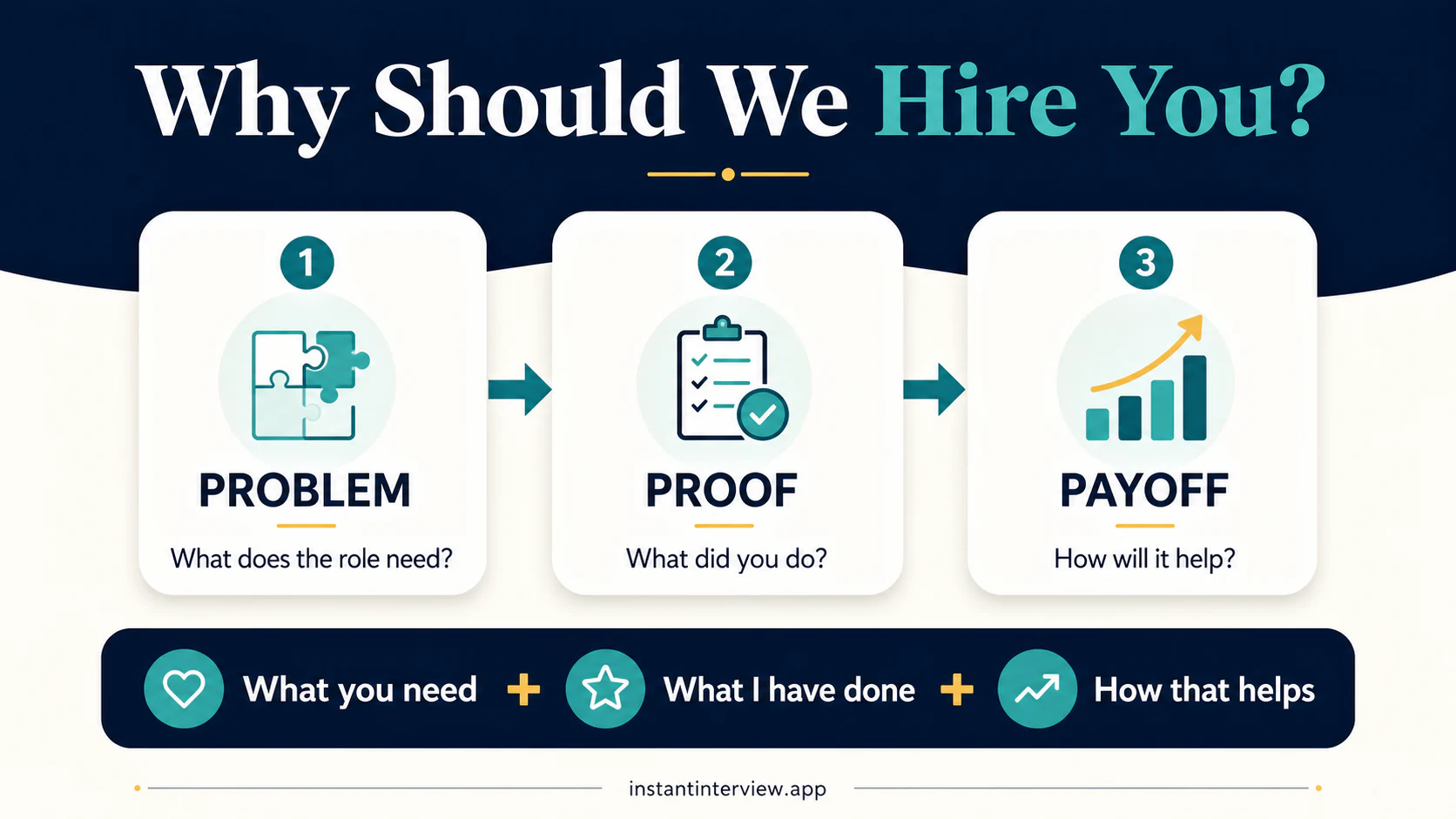
Once you have that proof, the companion "why should we hire you?" answer helps you turn it into a concise case for the employer.
Examples by situation
If you are applying for a first job
"I want to work here because the role combines customer contact with structured operations, and that is the combination I am trying to build my career around. I noticed the job description mentions accuracy, communication, and working across teams. In my course project and part-time work, the feedback I got most often was that I was reliable under pressure and clear with updates. I would like to bring that here and keep developing in a team that values those habits."
This is better than pretending to have deep industry experience. It uses the evidence you actually have.
If you are changing careers
"I want to work here because this role uses the part of my background I want to build on: translating messy information into clear action. I saw that the team needs someone who can work with different stakeholders and improve processes. In my previous role, I was often the person turning customer issues into practical fixes for the team. That is the thread I want to continue here, in a more focused role."
Career changers need a clear bridge. Do not apologise for the change. Explain the transferable pattern.
If you are interviewing for a senior role
"I am interested because the role seems to sit at the point where strategy has to become operating rhythm. The company is scaling, but the job description suggests the next challenge is consistency: clearer priorities, better cross-team handoffs, and fewer delivery surprises. That is work I have done before. I have helped teams move from heroic individual effort to repeatable systems, and that is the kind of contribution I would want to make here."
At senior level, the answer should sound less like enthusiasm and more like diagnosis.
What not to say
Avoid these:
- "I have always wanted to work for a company like this."
- "It seems like a great opportunity."
- "I need a new challenge."
- "The salary and benefits are attractive."
- "Your values really align with mine."
- "I saw the role and thought I would apply."
Some of those might be true. They are still not enough.
The phrase "your values align with mine" is especially overused. If you want to mention values, name the behaviour behind the value:
"The value that stood out was ownership, mainly because your case studies show teams staying close to customer problems after launch. That is how I like to work too."
Now it has evidence.
A 10-minute preparation method
If the interview is soon, do this:
- Open the job description and underline the 3 most repeated requirements.
- Open the company website and find 1 current priority.
- Open LinkedIn or recent news and find 1 proof that the priority is real.
- Choose 1 example from your experience that connects to it.
- Write a 3-sentence answer and practise it twice out loud.
Here is the template:
"What stood out to me was [company signal]. The role seems to need someone who can [role requirement], especially around [business pressure]. I have done similar work when [short proof], so this feels like a role where I could contribute quickly and keep building in the right direction."
Do not cram in every fact you found. One sharp fact beats five loose facts.
The answer checklist
Before the interview, check your answer against this:
- Can it only apply to this company, or could you say it anywhere?
- Does it mention the role, not just the brand?
- Does it include one real piece of evidence?
- Does it explain what you can contribute?
- Is it under 75 seconds?
- Does it sound like you when spoken out loud?
If the answer passes those six checks, it is probably strong enough.
The bigger point
In a tighter, noisier hiring market, interviewers are rewarding specificity. LinkedIn's applicant data shows why candidates feel the pressure. ONS vacancy data shows why UK roles feel scarcer. Indeed and NACE both point to the same employer preference: people who can communicate, prioritise, and connect their work to the organisation's needs.
That is what this question is really testing.
So do not answer "why do you want to work for us?" with admiration. Answer with alignment:
Company signal. Role fit. Specific contribution.
That is the difference between sounding interested and sounding hireable.
Jacob