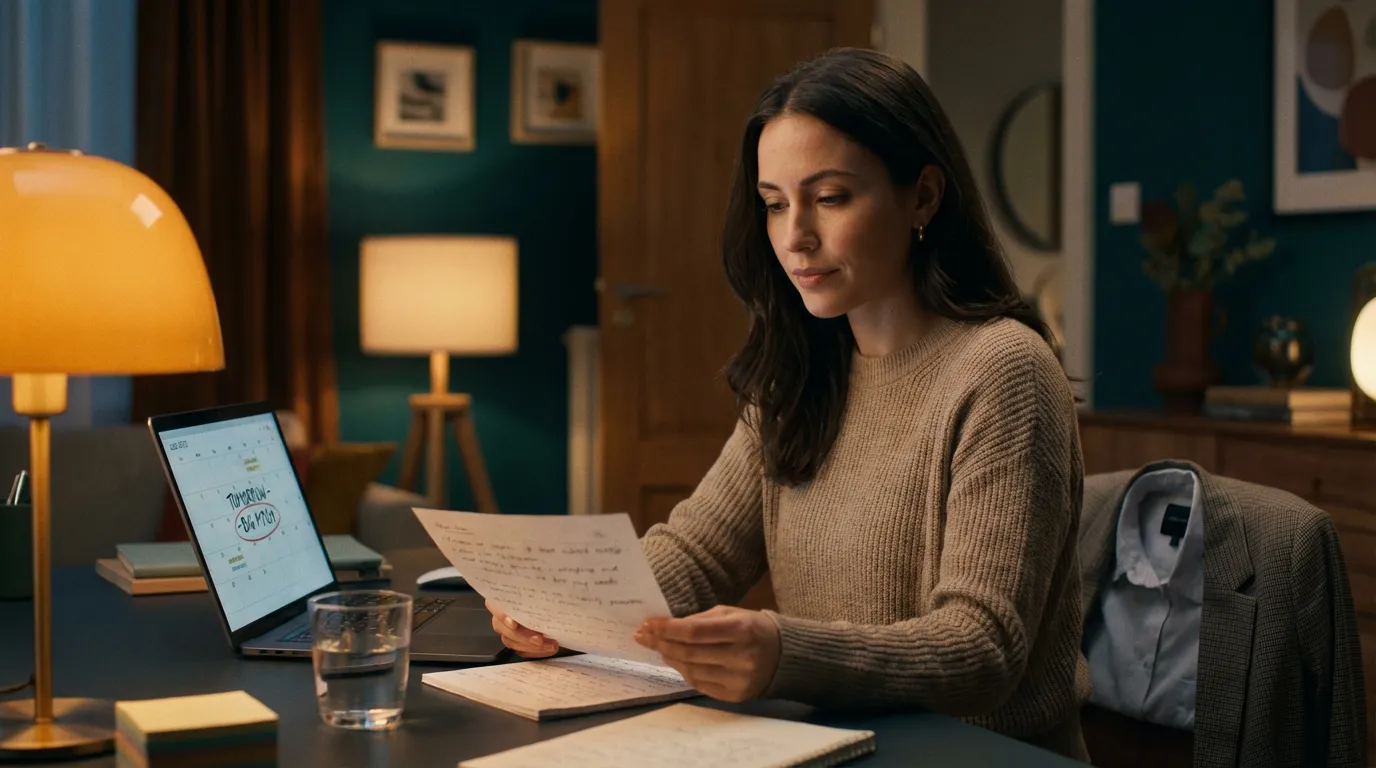
You've got an interview tomorrow. Maybe you've known for a week and kept putting off the prep. Maybe you just found out this afternoon. Either way, you have tonight, and tonight is enough.
This isn't a list of vague reassurances. It's a phase-by-phase plan: what to do this evening, how to approach the morning, and what to do in the final hour before you walk in.
Phase 1: Tonight (Do This Before 9 PM)
You have two to three hours of useful prep time this evening. Spend them in this order.
Research the company — 30 minutes, no more
You don't need to read the entire annual report. You need to know three things:
- What the company actually does. Not their tagline, but the real business model. Who are their customers? How do they make money?
- Something they've done recently: a product launch, a funding round, a market expansion. Check their LinkedIn page and the news tab on Google.
- Why this role exists. Re-read the job description. What problem are they trying to solve by hiring someone?
That's it. You're not writing a dissertation. You're preparing to sound like someone who did their homework, because you did.
Practise your answers out loud — 20 minutes
This is the step most people skip, and it's the one that matters most.
Reading over notes in your head is not practice. Your brain thinks it knows the answer; your mouth has never actually said it. There's a significant difference.
Say your answers out loud: to yourself, to a wall, or to an AI mock interviewer. Pay attention to where you hesitate, where you ramble, and where you run out of things to say.
Focus on three questions you're almost certain to face:
- "Tell me about yourself."
- One behavioural question relevant to the role (e.g. "Tell me about a time you dealt with a difficult stakeholder").
- "Why do you want this role?"
Use the STAR method for behavioural answers: Situation, Task, Action, Result. Keep each answer to 90–120 seconds. If you're going much longer, cut the situation and get to the action faster.
If you want structured feedback on how your answers actually sound (pace, filler word rate, how well your content is hitting), a quick session on Instant Interview gives you that in under 20 minutes.
Write down two or three questions to ask them — 10 minutes
Interviewers remember candidates who ask good questions. "What does success look like in this role in the first 90 days?" is always a strong one. So is "What are the biggest challenges someone coming into this position would face?"
Avoid questions answered on the company's website. It signals you didn't do the research you just spent 30 minutes doing.
Sort the logistics tonight, not tomorrow morning
Lay out your outfit now. Check your route and add 20 minutes to whatever Google Maps says. If it's a video interview, test your microphone, camera, and background, and close 15 tabs you don't need. You don't want to be doing any of this with adrenaline already running.
Stop preparing by 9 PM
One of the most common mistakes is over-preparing the night before. After a certain point, more revision just creates more anxiety. You've done the work. Cut off at 9 PM and do something that helps you wind down.
Phase 2: Sleep (The Prep Most People Skip)
Sleep is not passive. During sleep your brain consolidates everything you practised: the answers, the facts, the mental rehearsals. Showing up on five hours of broken sleep will undo half the work you did this evening.
Aim for seven to eight hours. If you struggle to fall asleep before important events, try the 4-4-4 breathing technique: breathe in for four counts, hold for four, out for four. Repeat for two minutes. It's not a myth. It genuinely dampens the stress response.
No doom-scrolling in bed. No re-reading your notes at midnight. You're done for the night.
Phase 3: The Morning Of
Eat something
Your brain runs on glucose. Skipping breakfast to save time is a false economy. A meal with protein and slow-release carbohydrates (eggs on toast, yoghurt with oats) will keep your thinking clearer than coffee alone.
Arrive early, but not too early
Plan to arrive at the building ten to fifteen minutes before your scheduled time. Sit in a nearby café or stay in your car until five minutes before. Walking in forty minutes early makes things awkward for everyone.
If it's remote, be logged in and ready two minutes before. Not thirty.
Move your body before you go in
A ten-minute walk is one of the most underrated interview prep tools. It burns off excess cortisol, improves working memory, and puts you in a more alert, positive state. You don't need a gym. Just don't sit still from the moment you wake up.
Phase 4: The Final Hour
This is not the time to learn new information. Your memory cannot absorb anything meaningful in the last hour before high pressure, so cramming now only increases anxiety.
What you can do:
- Skim your two or three prepared questions. Just a quick refresh, not a deep re-read
- Remind yourself of the three things you know about the company
- Do the 4-4-4 breathing if you feel your heart rate climbing
One reframe that helps: nerves and excitement produce the same physiological response. Before you walk in, tell yourself you're excited, not nervous. It sounds trivial; the research on it is not. Research from Harvard Business School found that telling yourself "I am excited" measurably improved performance under pressure compared to telling yourself to calm down.
In the Room (or on the Call)
A few things that make a bigger difference than most people expect:
Pause before you answer. Two seconds of silence feels enormous to you and invisible to the interviewer. It makes you sound considered, not slow. This is especially important for the first question. Don't start talking before you know what you want to say.
Speak at 120–160 words per minute. That's the range where listeners find speech most clear and credible. When you're nervous you'll want to speak faster, so actively slow yourself down, especially at the start of each answer.
Use STAR structure for every behavioural question. Not because interviewers explicitly score it (though some do), but because it forces you to give a complete answer. A common mistake is spending 90% of the time on the situation and rushing the result. The result, what actually happened in numbers if possible, is what interviewers remember.
Ask your prepared questions. Even if the conversation has been going well, always ask at least one. It signals genuine interest and gives you useful information about whether this is actually a place you want to work.
What Tonight Proves
One focused evening of preparation (company research, answer practice, logistics sorted) puts you ahead of a significant proportion of candidates who show up having done little more than re-read their CV.
You don't need weeks of prep for every interview. You need a clear plan, executed the night before.
Now close this tab and get started.
Andre, Instant Interview