
Why does "tell me about yourself" matter so much?
"Tell me about yourself" is almost always the first question in any interview. It sets the tone for everything that follows. A strong answer builds momentum and confidence. A rambling one puts you on the back foot for the rest of the conversation.
The question seems simple, but most candidates fumble it. They either recite their resume line by line, launch into their life story starting from college, or freeze up because they haven't prepared a concise narrative.
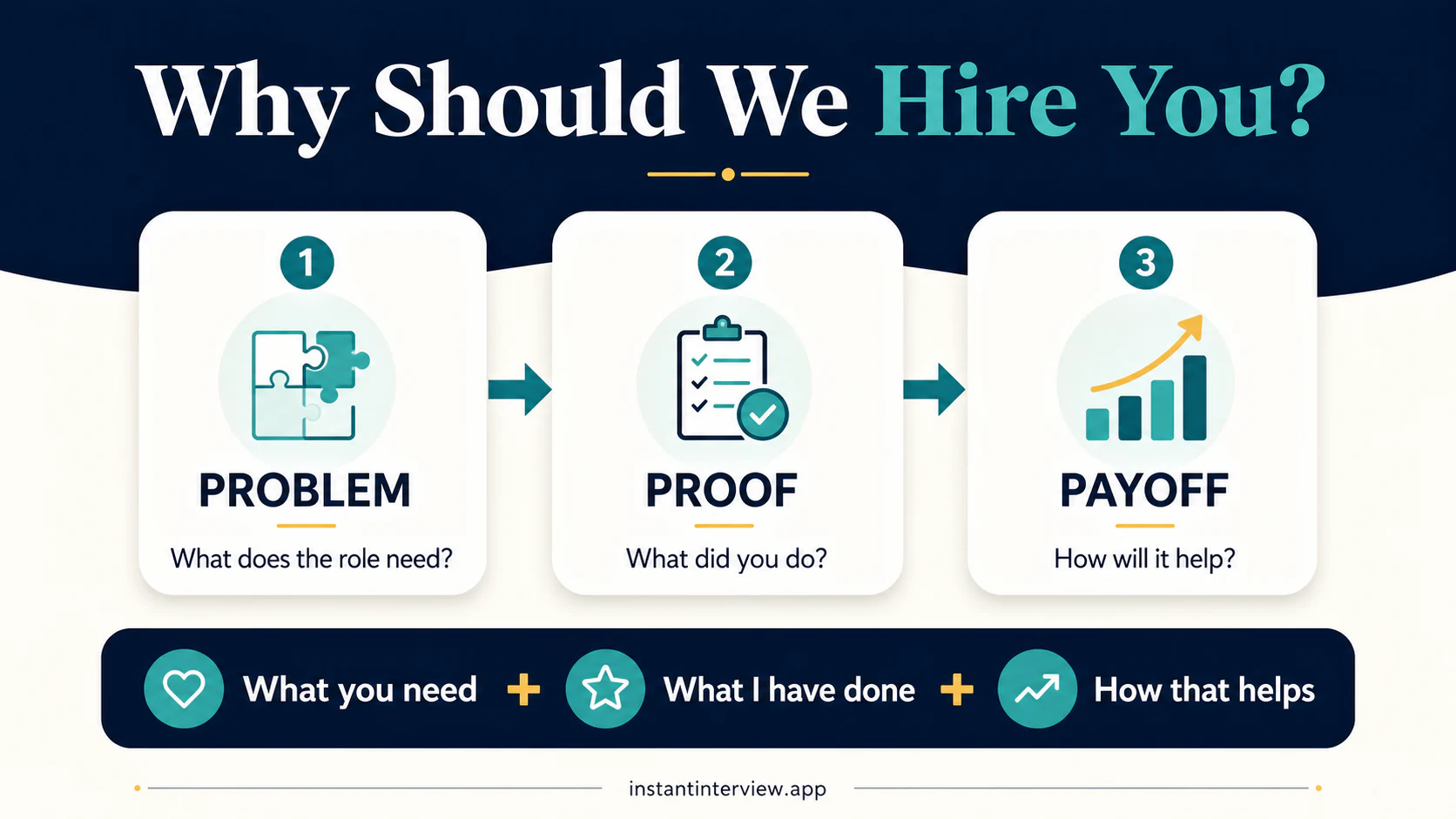
Here's the thing: interviewers aren't asking you to summarize your resume. They're asking you to frame a story, one that explains why you're sitting in that chair, for this specific role, at this specific company.
What's the best framework for answering "tell me about yourself"?
The most effective structure for answering "tell me about yourself" follows three beats:
1. Present — Where You Are Now
Start with your current role and what you do. Keep it to one or two sentences. Focus on the most relevant aspect of your current work.
Example: "I'm currently a senior product manager at a fintech startup, where I lead our payments platform team. Over the past two years, I've shipped three major features that grew transaction volume by 40%."
2. Past — How You Got Here
Briefly connect the dots. You don't need to cover every job, just the highlights that explain your trajectory and build credibility for the role you're interviewing for.
Example: "Before that, I spent three years at a larger company where I transitioned from engineering into product management. That technical background has been really valuable for working closely with engineering teams and making tradeoff decisions quickly."
3. Future — Why You're Here
End by connecting your story to this opportunity. This is where you show genuine interest in the role and company.
Example: "I'm excited about this role because you're solving payments infrastructure at a scale I haven't worked at yet, and the problems your team is tackling, like real-time settlement, are exactly the kind of complex challenges I want to take on next."
How long should "tell me about yourself" be?
Aim for 60 to 90 seconds, no more than two minutes. At a natural speaking pace that's roughly 150-225 words.
Why 90 seconds? It's long enough to give the Present-Past-Future structure room to breathe, short enough to leave the interviewer wanting follow-up questions rather than checking their watch. The moment you cross two minutes, the interviewer's attention is gone, and they're scanning your CV instead of listening.
Practise with an actual timer. Most people drastically underestimate how long their answer takes. The version that feels short in your head usually runs 2:30+ out loud.
If you're consistently over 90 seconds: cut the past section. You probably don't need to mention every job. Two highlights is usually enough.
How do you start "tell me about yourself"?
Start with the present, not your origin story. Open with your current role and the single most relevant accomplishment for the role you're interviewing for. Lead with what makes you a good fit, not chronology.
Strong opener: "I'm currently a senior product manager at a fintech startup, where I lead our payments platform team. Over the past two years I've shipped three major features that grew transaction volume 40%."
Weak opener: "Well, I grew up in Manchester, studied computer science at university, then I had a few different roles before..."
The strong opener earns the next 60 seconds of the interviewer's attention. The weak one wastes them.
What are the most common mistakes to avoid?
Going too long. Your answer should be 60 to 90 seconds. If you're talking for three minutes, you've lost the interviewer's attention. Practice with a timer.
Being too generic. "I'm a hard worker who loves solving problems" tells the interviewer nothing. Use specific details: numbers, product names, outcomes.
Starting with "Well, I was born in..." Nobody needs your origin story. Start with the present and work backward only as far as relevant.
Ignoring the job description. Your answer should be tailored to the role. Emphasize the parts of your experience that map most closely to what they're hiring for.
Sounding rehearsed. You should prepare your answer, but deliver it conversationally. Practice enough that the structure is automatic, but the words feel natural.
How do you tailor your answer for different roles?
The framework stays the same, but the emphasis shifts depending on the role:
- Engineering roles: Lead with technical accomplishments, systems you've built, scale you've operated at.
- Product roles: Lead with outcomes: user growth, revenue impact, successful launches.
- Leadership roles: Lead with team size, organizational impact, and strategic decisions.
- Career changers: Acknowledge the transition directly. Frame your previous experience as an asset, not something to apologize for.
How do you practise "tell me about yourself" effectively?
Next step: Practise your introduction with AI feedback on pacing and structure →
Try it: Run through a casual interview to test your opening answer →
The gap between a good answer and a great one is practice. Most people think about what they'll say but never actually say it out loud. When you practice verbally, you discover which transitions feel awkward, where you tend to ramble, and how long your answer actually takes.
Record yourself answering "tell me about yourself" and listen back. You'll immediately notice things you want to change: a filler word habit, a section that drags, a missed opportunity to mention a key accomplishment.
Even better, practice with a simulated interviewer who can give you real-time feedback on your pacing, structure, and delivery. The more reps you get, the more natural your answer becomes, and the stronger first impression you'll make when it counts.
Quick checklist before your interview
- Your answer is under 90 seconds
- You start with your current role
- You include at least one specific accomplishment with a number
- You connect your story to the specific role
- You've practiced it out loud at least three times
- You sound conversational, not scripted
Susie, Instant Interview