Your CV Isn't Being Read Anymore. Here's What Replaced It.
The job application is broken. Not "a bit inefficient" broken. Structurally, fundamentally broken. In 2026, AI tools let candidates mass-apply to hundreds of jobs in a single afternoon. Resumes are generated, tailored, and submitted by bots. Cover letters are indistinguishable from each other. And recruiters? They're drowning.
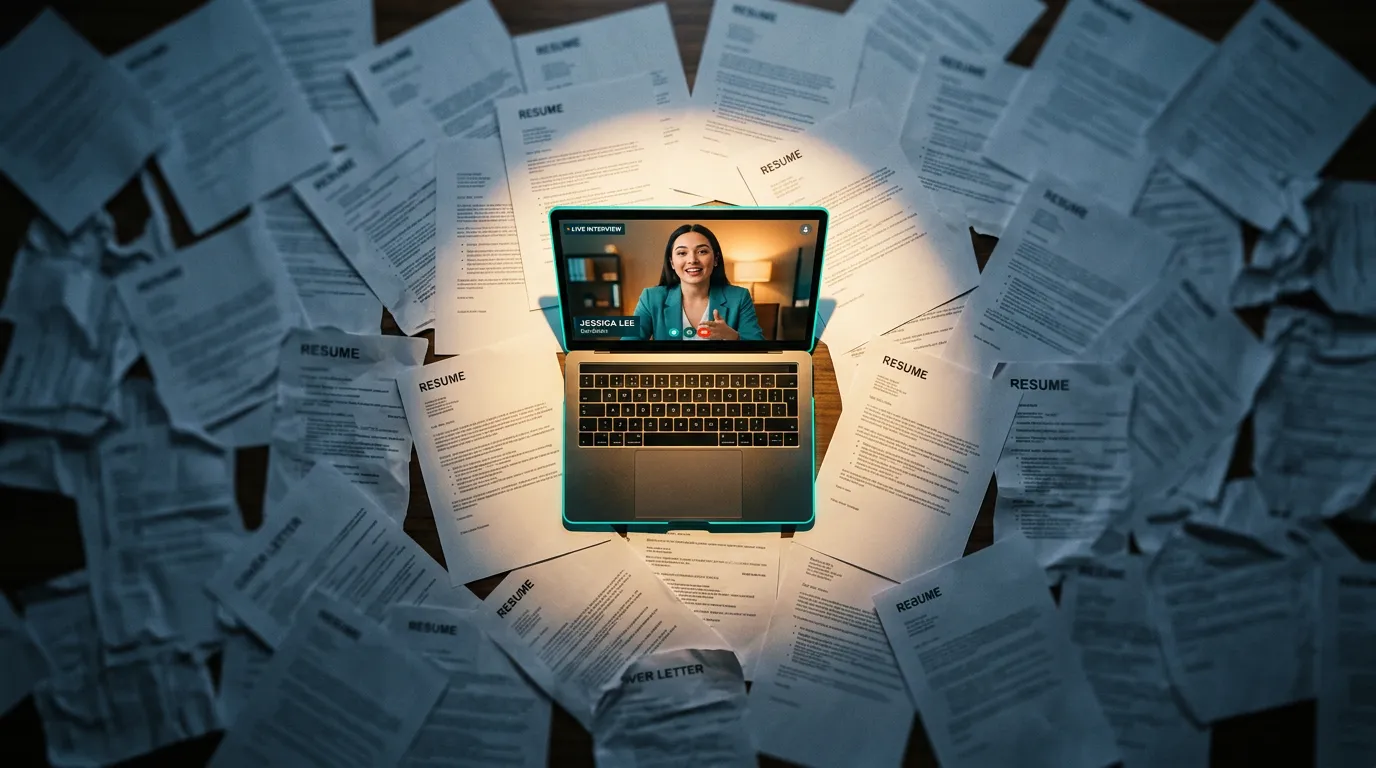
The result is a hiring shift that most candidates haven't caught up with yet: the live interview now carries almost all the weight of the hiring decision. Everything before it (the CV, the cover letter, the application form) has become noise.
If you're job hunting right now, this changes everything about where you spend your prep time. Let me explain why, and what to actually do about it.
The Numbers Behind the Flood
AI use across HR tasks hit 43% in 2026, up from 26% in 2024, according to research from MSH. But that's the employer side. The candidate side is wilder.
Mass-apply tools, the ones that auto-tailor your CV and fire it at 200 open roles before lunch, have exploded. SHRM reported that employers are now "inundated with applicants leveraging AI-enabled tools to mass-apply, tailor resumes, and even auto-generate interview responses in real time." Some recruiters are seeing application volumes triple with no improvement in candidate quality.
Here's the problem in plain numbers:
| What's Changed | Before AI Tools | After AI Tools (2026) |
|---|---|---|
| Avg. applications per role | 50–150 | 400–1,000+ |
| Time to tailor a CV | 30–60 min | Under 30 seconds |
| Cover letter distinguishability | Moderate | Near zero |
| Recruiter trust in written applications | High | Collapsing |
| Weight of the live interview | One of several signals | The primary signal |
When every application looks polished, polished applications stop meaning anything. The resume has become a ticket to the door. The interview is the door.
Why "Precision Hiring" Means You Can't Wing It
Here's the thing. Companies aren't responding to the flood by hiring faster. They're responding by hiring slower and pickier.
Robert Half's 2026 hiring outlook describes the shift as "precision hiring": fewer roles, higher bars, more interview rounds. HR Dive's research confirms the trend: the 2026 hiring market is thawing after a brutal downturn, but employers are being extraordinarily selective.
What does this mean practically? Three things:
1. Fewer shots on goal. Companies are posting fewer roles and filling them more carefully. You might get one interview at your dream company. Maybe two. Not five.
2. More interview rounds. When the application can't be trusted as a filter, the interview process expands to do the filtering instead. Expect more stages: phone screens, technical rounds, behavioural deep-dives, culture fits.
3. Higher scrutiny per round. I spoke to a hiring manager at a Series B startup last month who told me she now records interview notes in real time against a structured rubric. She said, and I'm paraphrasing: "I used to go on gut feel for the first round. I can't afford to anymore. There are too many people who look perfect on paper and fall apart when you ask them to think out loud."
That last point is the one most candidates miss. The interview isn't a formality anymore. It's the entire evaluation.
The Skills That Show Up in Conversation (and Nowhere Else)
A beautifully formatted CV can tell you someone knows React. It can't tell you how they'd handle a production outage at 2am while the PM is panicking and the client is on the line.
That's the gap. And it's why live interviews have become the primary hiring signal. There are things that only emerge in conversation:
Thinking under pressure. Not "I handle pressure well" written on a CV. Actually watching someone structure their thoughts when they don't have the luxury of editing.
Genuine depth vs. surface knowledge. AI can generate a flawless answer to "What's your experience with microservices?" A follow-up question like "Walk me through a specific trade-off you made between synchronous and async communication in that system" separates the real from the rehearsed.
Communication clarity. How someone explains a complex idea in real time (their pace, their structure, their ability to read whether the interviewer is following) can't be faked on a document.
Self-awareness. The candidates who can say "I got that wrong, and here's what I learned" without sounding rehearsed. That kind of honesty is almost impossible to script convincingly.
I once ran mock interviews for a group of bootcamp graduates. Technically, they were all at roughly the same level. But the ones who'd practised speaking their answers out loud, not typing them, speaking them, were in a completely different league. Their answers weren't better. Their answers were clearer. And clarity, honestly, is what interviewers are buying.
The AI Cheating Problem Is Making This Worse
Here's a wrinkle most candidates don't know about. Employers are now actively worried about candidates using AI during interviews. Real-time AI answer assistants, hidden second screens, even deepfake concerns. It's all on the radar.
Only 26% of candidates trust AI to evaluate them fairly, according to boterview's 2026 data. But here's the flip side: employers increasingly don't trust candidates' written work either. The EU AI Act and New York City's automated hiring audit laws are forcing transparency on the employer side, but nothing prevents candidates from using AI to generate their answers.
The result? Companies are doubling down on formats where cheating is hardest:
- Live voice interviews with real-time follow-ups (no time to consult a second screen)
- Behavioural deep-dives using the STAR method with probing follow-up questions
- Whiteboard and live-coding sessions where the interviewer watches your process, not just your output
- Culture-fit conversations that go off-script deliberately
The common thread: they all require you to be present, thinking, and speaking in real time. That's the one thing AI can't reliably fake. Yet.
What to Actually Do About This
If the interview carries all the weight, then interview preparation isn't optional. It's the entire strategy. Here's what that looks like in practice.
Shift Your Time Budget
Most candidates spend 80% of their prep time on applications and 20% on interview practice. Flip it.
| Activity | Old Time Split | 2026 Time Split |
|---|---|---|
| CV tailoring & applications | 70–80% | 20–30% |
| Interview practice (speaking out loud) | 10–15% | 40–50% |
| Company research | 5–10% | 15–20% |
| Networking & referrals | 5% | 10–15% |
Your CV still needs to be solid. But spending three hours tweaking bullet points for a single application makes no sense when 400 other AI-polished resumes are landing in the same inbox. Spend that time practising your answers out loud instead.
Practise Speaking, Not Writing
This is the single biggest mistake I see. Candidates prepare by writing answers in a Google Doc and reading them over. That's not interview practice. That's essay practice.
Speaking an answer out loud is a completely different cognitive task. You discover that your beautifully written STAR response turns into a rambling two-minute monologue when you actually try to say it. You discover your filler word rate spikes when you hit the "Action" section because you haven't internalised the transition.
The fix is embarrassingly simple: say your answers out loud. Record yourself. Listen back. Do it again. If you want structured feedback on your pace, filler rate, and STAR structure, that's exactly what Instant Interview measures in real time, but even talking to your bathroom mirror is better than silently reading your notes.
Prepare for Follow-Up Questions, Not Just First Questions
The ten behavioural questions you'll probably get asked? You can prepare for those. Everyone does. The follow-ups are where the interview is actually decided.
After "Tell me about a time you dealt with a difficult stakeholder," expect:
- "What would you do differently now?"
- "How did you know your approach was working?"
- "What did you learn about yourself from that situation?"
You can't script answers to questions you haven't heard yet. But you can practise thinking on your feet by answering follow-ups in real time, structuring your thoughts under pressure, staying coherent when the conversation goes somewhere unexpected.
Research the Company Like It's a Conversation, Not an Exam
Company research in 2026 isn't about memorising the mission statement. It's about having something interesting to say when the interviewer asks "Why us?"
Go beyond the careers page. Read their recent blog posts. Look at what their engineering team is shipping. Check their Glassdoor reviews, not to scare yourself, but to find the real challenges the company is facing. Then connect those challenges to your experience.
The candidates who stand out aren't the ones who can recite the company values. They're the ones who say something like: "I noticed you're migrating from a monolith to microservices based on your recent engineering blog post. I went through exactly that transition at my last role and learned some hard lessons about service boundaries." That's a conversation. That's memorable.
The Bottom Line
The job application used to be a meaningful part of how you got hired. It filtered candidates, demonstrated effort, and gave recruiters real signal about who was worth interviewing.
AI tools broke that. When everyone's application looks equally polished, applications stop filtering. The entire weight of the hiring decision has shifted to the one place where authenticity still shows: the live conversation.
That's not a bad thing, by the way. If you're actually good at what you do, this shift works in your favour. It means the candidates who can clearly articulate their experience, think on their feet, and have genuine depth will win, regardless of whether their CV was formatted by a human or a machine.
But only if you prepare for it. The interview isn't a formality anymore. It's the whole game.
Jacob, Instant Interview